Class support
Review current topics, clarify difficult concepts and work through school assignments.
Online IB Economics tutoring for microeconomics, macroeconomics and the global economy, with Paper 1, Paper 2, HL Paper 3 and commentary practice.
For international school students in Hong Kong and worldwide. Lessons follow the student's course guide, school pace and current learning needs.
Lessons cover diagram-based analysis, data response and written evaluation. HL includes a Paper 3 with quantitative work and policy recommendations. The portfolio comprises three commentaries based on published news articles and uses different key concepts.
Review current topics, clarify difficult concepts and work through school assignments.
Practise the relevant question types and review answers against the applicable marking guidance.
Plan the work, discuss research choices and receive feedback on drafts against the subject criteria.
The course has four units:
| Component | SL | HL |
|---|---|---|
| Paper 1: extended response | 30% | 20% |
| Paper 2: data response | 40% | 30% |
| Paper 3: policy paper (HL) | — | 30% |
| IA: portfolio of three news commentaries | 30% | 20% |
Paper 1 lasts 1 hour 15 minutes and Paper 2 1 hour 45 minutes. SL is about 150 hours and HL about 240.
Core ideas such as supply and demand, elasticity, externalities and AD/AS have standard diagrams. Practise drawing them quickly and accurately, fully labelled, and explain the change on the diagram in your writing.
The top bands of Paper 1 require evaluation: short run versus long run, different stakeholders, assumptions and priorities. Explanation without evaluation stays in the middle bands.
Specific countries, policies or news stories in your answers lift the application marks. Collect a few usable examples for each unit as you go.
Paper 2 and HL Paper 3 include calculations such as elasticity, multipliers, GDP and exchange rates. These are reliable marks; practise until you are quick and accurate.
The three commentaries must cover different units, each built around one key concept and no more than 800 words. Choose short, specific articles that support a relevant diagram.
HL adds Paper 3, a policy paper with more calculation and policy analysis. Students heading for economics, finance or business often take HL Economics, although many economics degrees care more about Mathematics AA HL. For interest or as a social science option, SL is often enough. Follow each university's requirements.
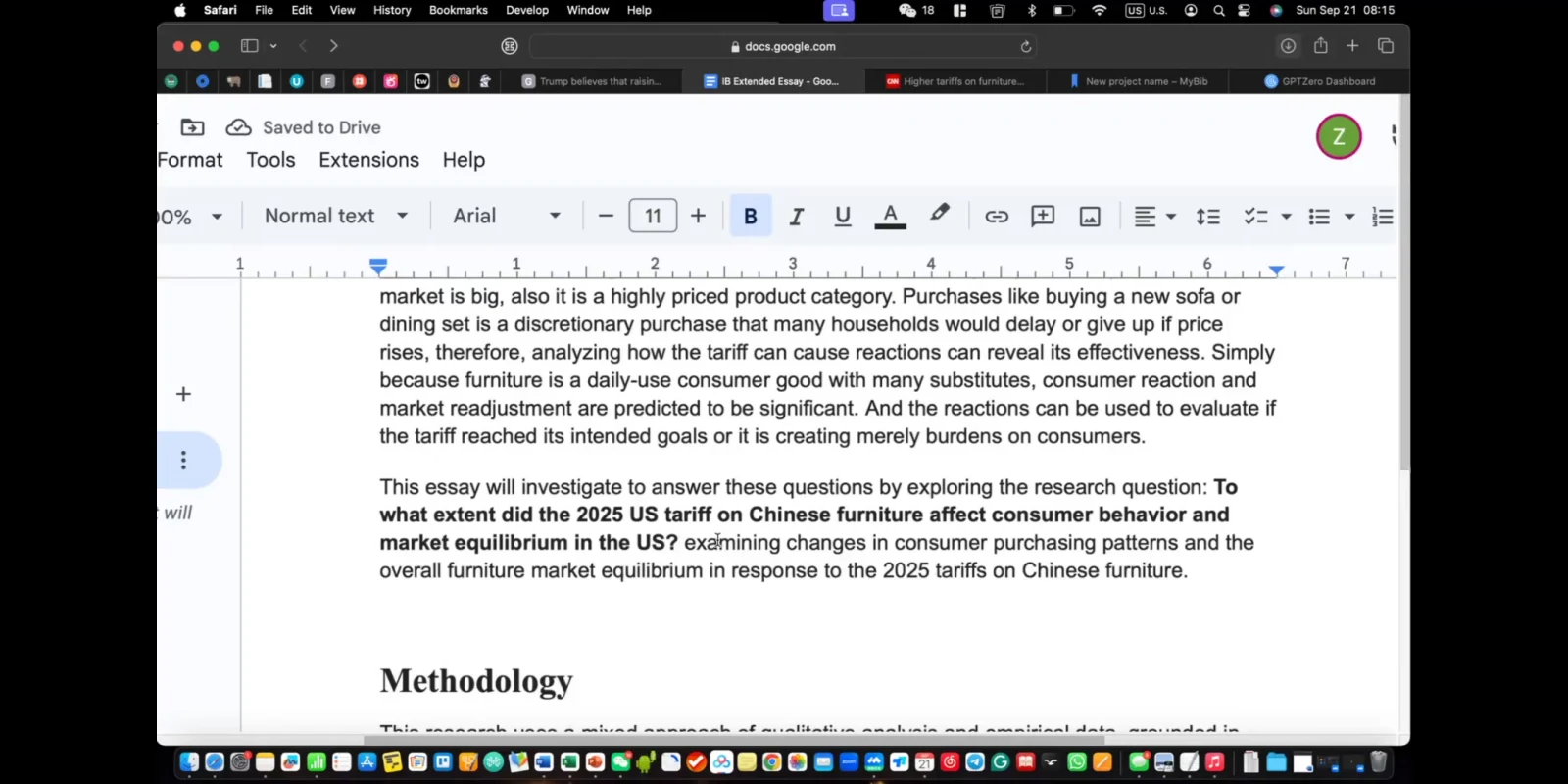
Comments on an EE research question and methodology, with discussion of how the analysis supports the argument.
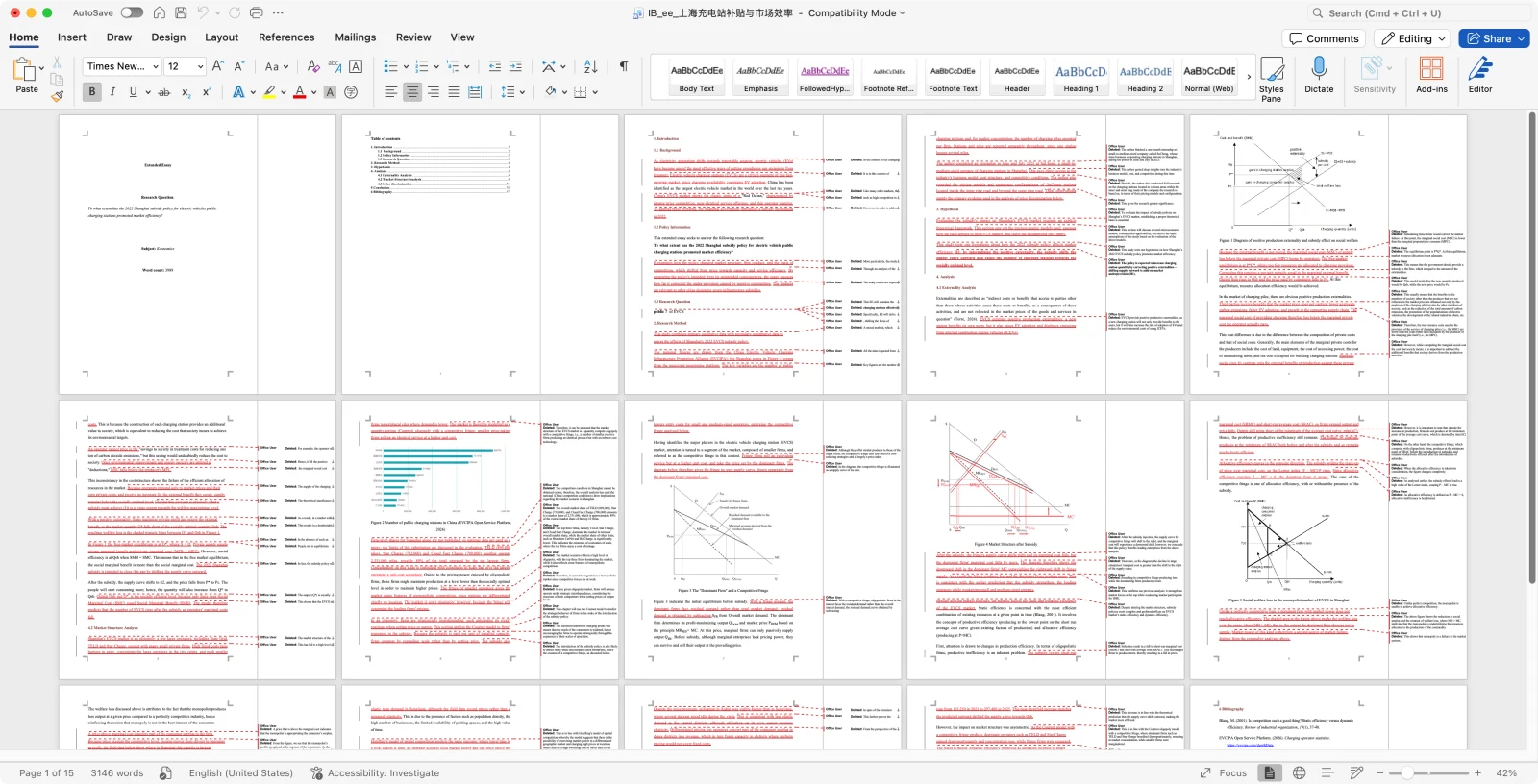
An Economics EE draft on charging-station subsidies and market efficiency, with comments and revisions.
HL includes Paper 3, which uses supplied data for calculations and policy recommendations. HL also covers additional material within microeconomics and macroeconomics.
The portfolio consists of three commentaries analysing news articles published within a year and applying different key concepts. It contributes 30% at SL and 20% at HL.
Yes. Supply and demand, elasticity, market failure and macroeconomic equilibrium are commonly analysed with diagrams. Labels should be accurate and the written answer should explain what each diagram shows.
SL calculations mainly use foundational operations such as percentages, elasticity and index numbers. HL has more quantitative work, including calculations in Paper 3.