Class support
Review current topics, clarify difficult concepts and work through school assignments.
Online IB Biology tutoring for the revised course, with Paper 1A/1B and Paper 2 practice, SL and HL support, and scientific investigation feedback.
For international school students in Hong Kong and worldwide. Lessons follow the student's course guide, school pace and current learning needs.
The revised syllabus is organised into Unity and diversity, Form and function, Interaction and interdependence, and Continuity and change. Paper 1 is divided into 1A multiple-choice questions and 1B data and experimental questions. The investigation contributes 20%.
Review current topics, clarify difficult concepts and work through school assignments.
Practise the relevant question types and review answers against the applicable marking guidance.
Plan the work, discuss research choices and receive feedback on drafts against the subject criteria.
The revised course is organised into four themes, each studied from molecules and cells up to organisms and ecosystems:
| Component | SL | HL | Weight |
|---|---|---|---|
| Paper 1 (1A multiple choice + 1B data and experimental questions) | 1 h 30 min | 2 h | 36% |
| Paper 2 (short and extended response) | 1 h 30 min | 2 h 30 min | 44% |
| Scientific investigation (IA) | In school | In school | 20% |
The current course was first examined in May 2025. SL is about 150 teaching hours and HL about 240; HL goes deeper into the same themes. The former options and Paper 3 were removed.
Cell structure, biological molecules, inheritance and energy flow. These ideas come back in every theme; if they are shaky early on, every later unit becomes harder.
Paper 1B is about data and experimental work in unfamiliar contexts: reading graphs, processing data and evaluating methods. It needs different practice from multiple choice and extended response.
Paper 2 marks are awarded for the points in the markscheme. Check your wording, working and units against it, not only whether the final answer is right.
The scientific investigation is worth 20%. Make the research question specific about measurable variables and ranges, and run a pilot to check the data will work before writing up.
The revised course was first examined in 2025. Older papers are still useful for topics that remain in the syllabus, but use the 2025-onward papers for question types and weighting.
HL is about 240 hours and SL about 150; HL goes deeper in all four themes, with more detailed terminology and processes. Students aiming for medicine, biomedical science, pharmacy or life sciences often take HL Biology; some medical schools weight HL Chemistry more, with HL Biology as an advantage. For other paths SL is often enough. Follow each university's requirements.
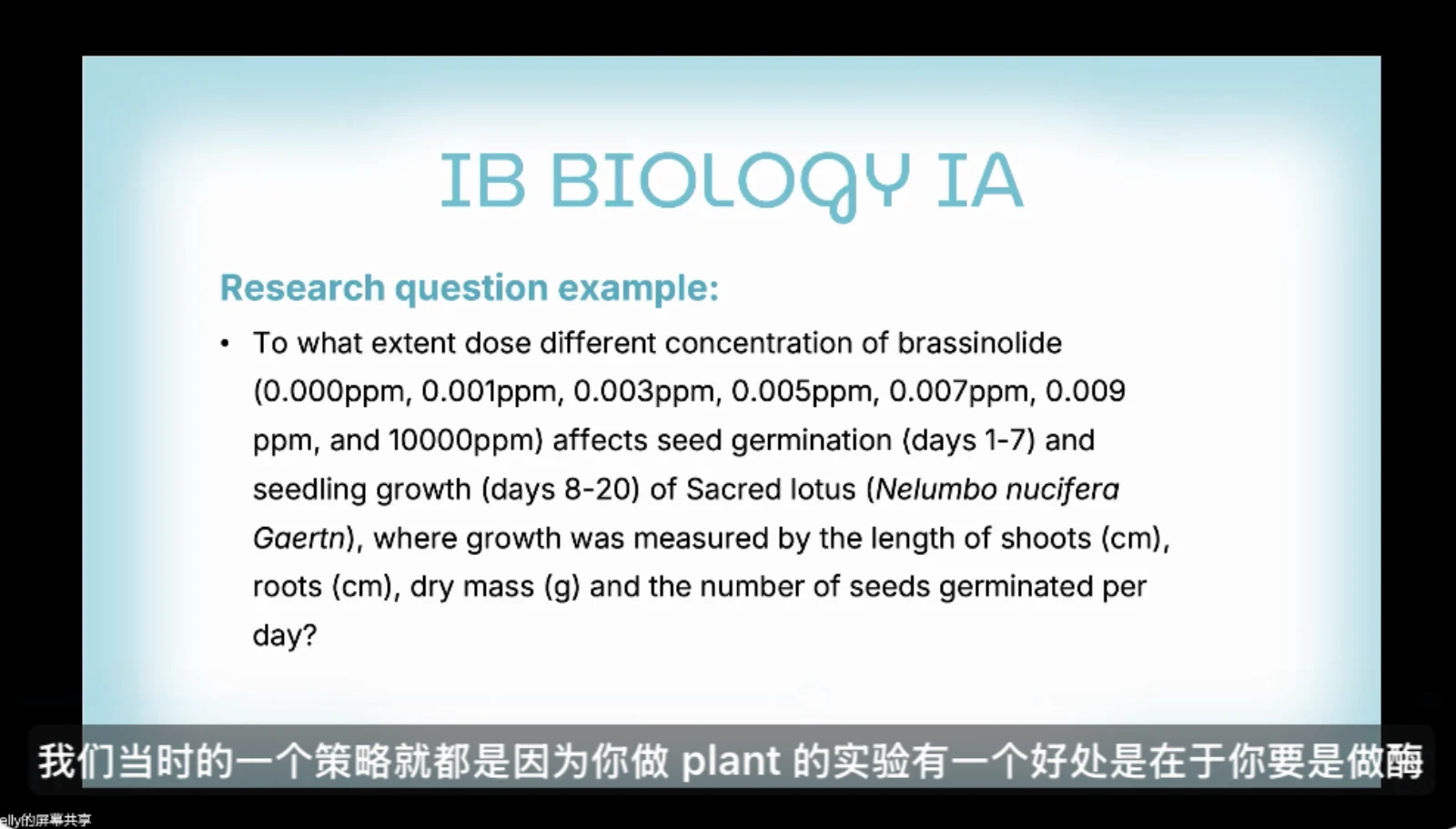
Use a Biology IA example to clarify variables, scope and whether the investigation can be carried out.
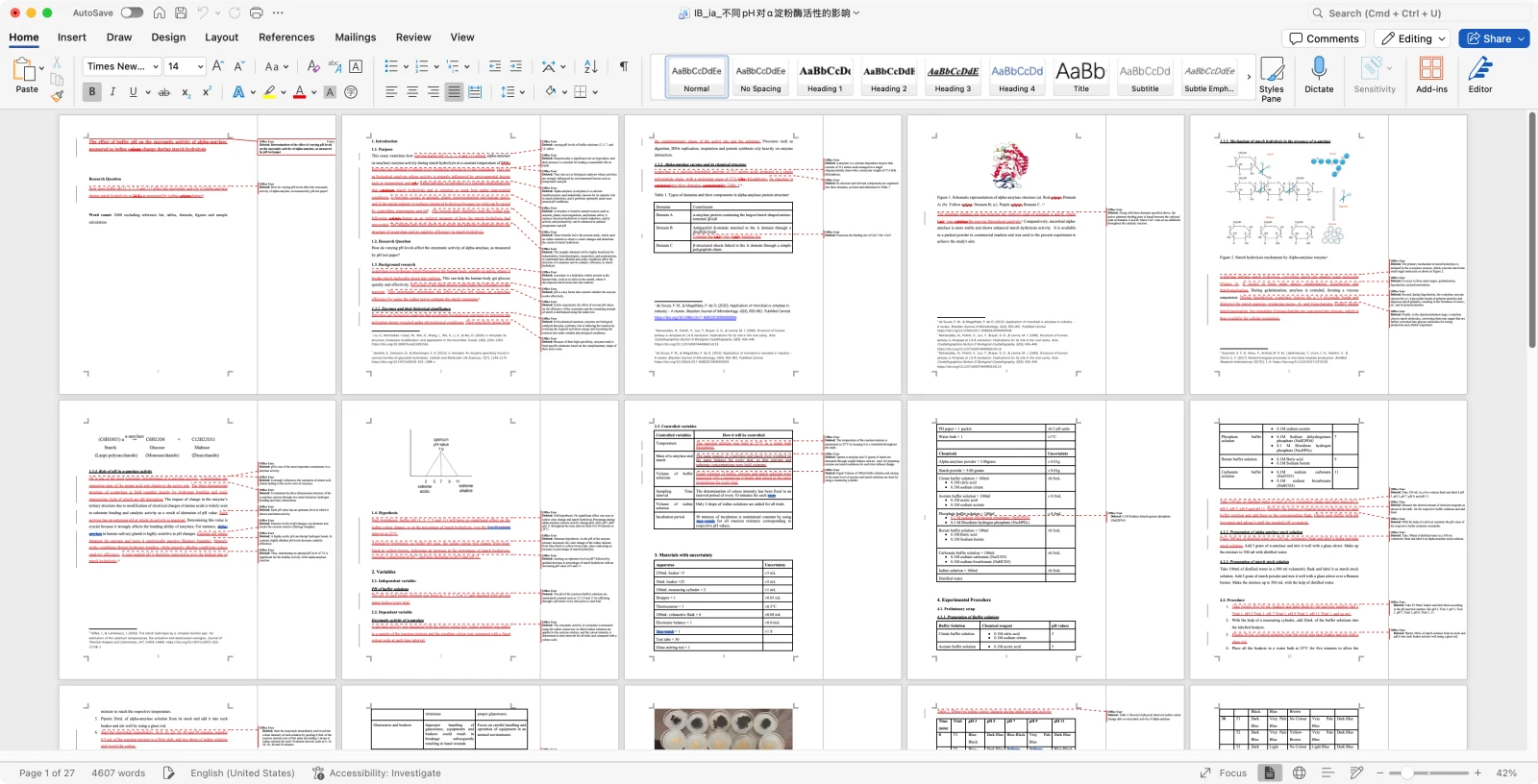
An annotated Biology IA draft investigating the relationship between pH and alpha-amylase activity.
HL covers the themes in greater depth and has longer examinations. Paper 1 contributes 36%, Paper 2 44% and the scientific investigation 20% at both levels.
First examined in May 2025, the course uses four themes: Unity and diversity; Form and function; Interaction and interdependence; and Continuity and change. Paper 1 has 1A multiple-choice and 1B data and experimental questions; the former options and Paper 3 were removed.
It is a student-designed scientific investigation written up as a report. The teacher marks it and the IB moderates samples. Assessment considers research design, data analysis, conclusion and evaluation.
It focuses on data and experimental work, including interpreting graphs, processing data and evaluating methods in unfamiliar contexts.
Medicine programmes commonly require HL Chemistry, and many also require HL Biology or another science. Check the current entry requirements of each university.